
Article
OPS-0001 · 2026-06-23The Decision Debt Trap: The Hidden Operational Cost of Unresolved Decisions

How organizations quietly accumulate work they never chose
Most leaders have been in a meeting that starts with a reasonable question:
Why does this process take so long? Why are there four separate approval steps for the same request? Who actually owns this decision?
The answers, when they finally surface, almost always trace back to the same place.
Not a broken system. Not an incapable team.
A decision that was never fully made, and an organization that kept running anyway.
The issue is not that organizations make the wrong decisions. It is that unfinished decisions leave behind operational residue. That residue is decision debt.
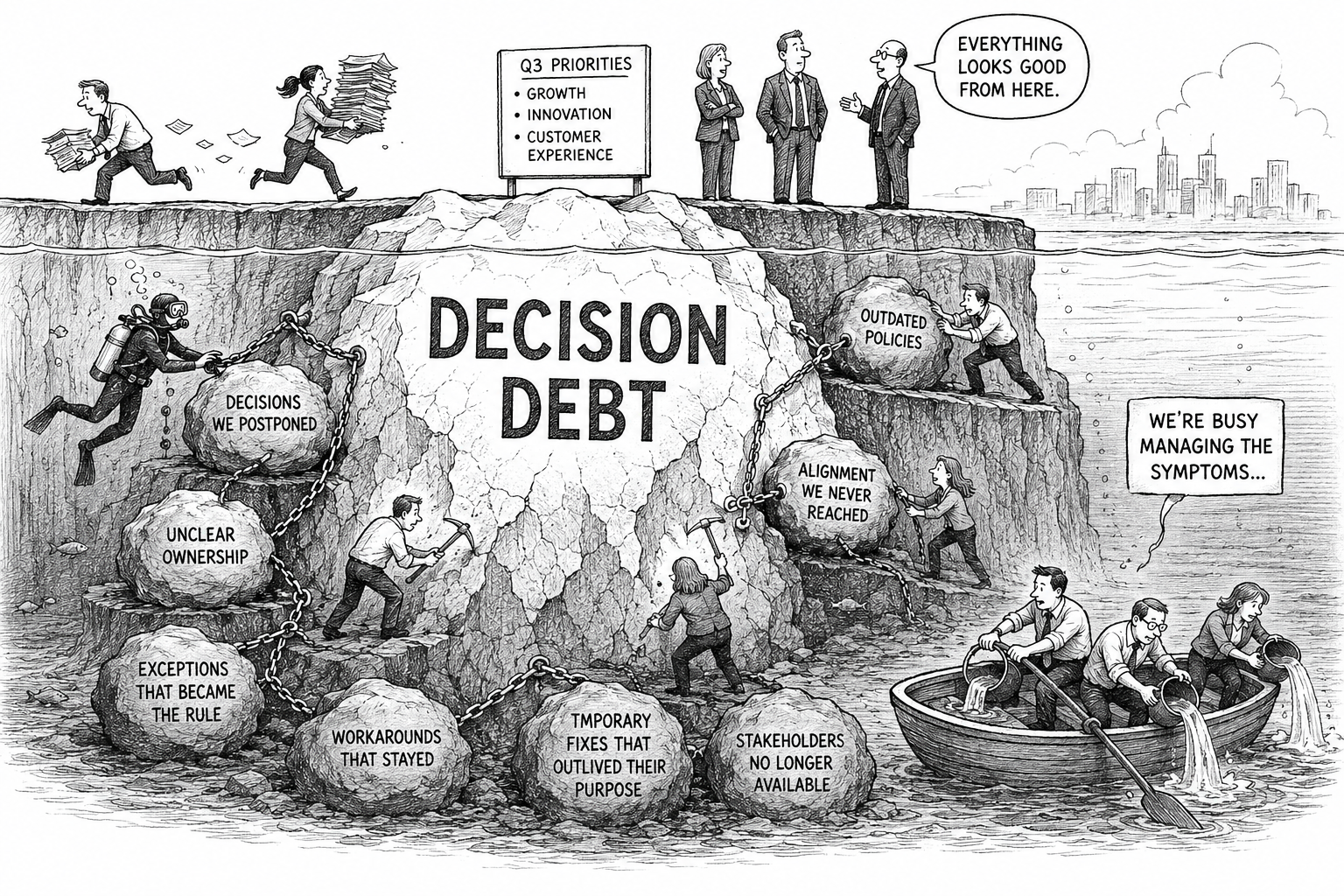
Decision debt is the operating burden created when organizations postpone, avoid, or partially resolve important decisions, leaving teams to compensate through workarounds, exceptions, and informal processes.
It accumulates quietly. It compounds over time. And by the time leaders recognize how heavy it has become, teams may have been carrying it for years.
The gap between what leaders see and what teams are actually dragging around is where decision debt thrives. On the surface, priorities appear clear and processes appear stable. Below the surface, employees are often navigating postponed decisions, unclear ownership, outdated workarounds, and exceptions that quietly became permanent.
How it accumulates
Most decision debt does not come from bad decisions.
It comes from incomplete ones.
Someone says, “We’ll revisit this next quarter,” and the quarter passes.
A temporary spreadsheet gets created while a system upgrade is pending, and two years later that spreadsheet has seventeen tabs and its own informal training process.
An exception is approved for one customer, then another, and eventually the exception becomes the standard while the original policy sits untouched in a folder no one can find.
Each moment feels manageable in isolation.
Together, they create an organization where a surprising amount of daily work exists not because anyone chose it, but because no one went back to undo it.
I watched one operations team defer a manual approval redesign for almost a full year. Something more urgent always appeared. After eleven months, the workaround had grown elaborate enough that fixing it required three people to step away from other priorities for six weeks.
The original fix would have taken two weeks at the beginning.
The delay was not a single bad decision. It was eleven reasonable decisions in a row.
That is how decision debt forms.
Why it becomes dangerous at scale
What makes decision debt dangerous is that it scales with growth.
Every new employee, team, customer, or process inherits the unresolved complexity that already exists.
A workaround that affects five people may feel harmless.
The same workaround affecting five hundred people becomes an operating model.
A confusing approval path that slows one team becomes a company-wide bottleneck when every department builds similar habits around it.
Growth does not eliminate decision debt.
It multiplies it.
The organizations that struggle most are often not the ones making the worst decisions. They are the ones accumulating unresolved decisions faster than they can identify and retire them.
The four places it hides
Postponed decisions are the most visible source, but not the only one.
Unclear ownership
When responsibility is ambiguous, organizations often respond by adding more people to the conversation, more approvals, and more check-ins.
This looks like collaboration.
It is usually a more expensive version of confusion.
Many recurring meetings are not communication problems. They are ownership problems that were never named.
Temporary workarounds
These are the quietest source of decision debt.
They arrive with good intentions and an assumption that someone will eventually replace them.
That someone rarely appears.
The workaround becomes infrastructure.
Exception creep
This is the slowest source.
A process that starts clean accumulates edge cases over months and years until new employees need weeks of context just to understand situations that were never part of the original design.
The process has not failed.
It has been buried.
Unresolved trade-offs
Some decisions remain open because leaders are trying to avoid choosing between competing priorities.
But avoiding a trade-off does not remove it.
It simply pushes the cost into daily operations.
Someone still absorbs the complexity. Someone still spends the extra hour. Someone still explains why the process works the way it does.
What it actually costs
The direct cost of decision debt is time.
The indirect cost is harder to measure but often more damaging.
Employees spend cognitive energy navigating ambiguity that should not exist. Leaders revisit conversations that were never conclusively resolved. Teams build workarounds not because they lack discipline, but because the organization has not given them a stable foundation to work from.
The same issues resurface in slightly different forms across meetings that were supposed to be about something else entirely.
Over time, this creates a subtle erosion of confidence.
Not in individuals.
In the organization’s ability to make things clear and keep them that way.
People stop expecting decisions to land cleanly. They start creating their own buffers against uncertainty.
That is the compounding effect.
It does not always appear in dashboards.
It appears in how people talk about getting things done.
How to start reducing it
The goal is not to make more decisions.
It is to resolve uncertainty and remove complexity that no longer serves a purpose.
A useful starting point is a short audit of recurring friction.
Which discussions keep coming back?
Which workarounds survived multiple planning cycles?
Which approval steps can no one explain in terms of current risk?
Which ownership questions appear more than once a month?
These are not complicated questions.
They are simply rarely asked with the intention of acting on the answers.
A practical way to identify decision debt is to run a Decision Debt Audit, not to find more problems, but to find where the organization is paying for decisions that are already outdated.
Start by looking for four signals:
Decisions that keep returning.
Which topics appear repeatedly in leadership meetings without a final resolution? Recurring conversations are often evidence that the organization is paying the cost of an unfinished decision.
Workarounds that became normal.
Which manual steps, spreadsheets, approval paths, or informal processes were introduced as temporary fixes but now feel permanent?
Ownership gaps.
Where does work slow down because everyone is involved but no one is clearly accountable?
Exceptions that became the operating model.
Which exceptions happen so frequently that they are no longer exceptions at all?
The goal is not to eliminate every exception or simplify every process.
The goal is to identify where the organization is spending energy supporting decisions that no longer reflect how the business actually operates.
The organizations I have seen navigate this well share one habit:
They treat outdated decisions the same way they treat outdated software.
They retire them.
They set review points.
They assign ownership for asking whether a process still reflects a choice someone would make today.
One additional practice separates organizations that reduce decision debt from those that simply document it:
They assign owners to retired decisions.
When a process, exception, or workaround is removed, someone needs to own the decision that replaced it. Otherwise, organizations often recreate the same complexity months later because no one is accountable for protecting the new operating model.
A retired decision should have the same clarity as a new one:
What changed?
Why did it change?
Who owns it going forward?
When will it be reviewed again?
Without ownership, even good decisions slowly become future decision debt.
The most impactful operational improvements I have seen did not come from new technology or new headcount.
They came from finally resolving something old.
Clarity, it turns out, scales in ways complexity never does.
The clearest competitive advantage is often invisible
Organizations that systematically reduce decision debt move faster, execute more cleanly, and adapt more easily.
Not because they have better people or bigger budgets.
Because their people are not spending meaningful portions of the day managing the residue of decisions that were never finished.
The organizations still carrying that weight usually know something is off.
They just keep scheduling meetings to figure out why.
The answer is almost always somewhere in the past.
A decision that stopped short.
A workaround that stayed.
An exception that multiplied.
Every organization carries some decision debt.
The difference is whether leaders continue paying interest on it.
The work was never chosen.
But someone is still doing it.