
Article
OPS-0001 · 2026-06-04The 2026 COO Operating Brief: Why 42 B2B Operations Moved Verification From a Process to a Headcount Line

The 2026 COO Operating Brief: Why 42 B2B Operations Moved Verification From a Process to a Headcount Line
What does a COO seat look like when the head of customer success, the head of operations, and the head of internal IT all merge into a single agent stack supervised by one person?
That question hit our 42-operator cohort in Q1 2026, and the answer is that the COO ends up with one new direct report and three fewer legacy ones. The new direct report is a verification operator. The legacy roles get absorbed into agent stacks supervised through audit dashboards. The operations that hired the verification operator inside Q1 stabilized inbound DM volume within 6 to 8 weeks of the hire. The operations that kept verification as a process rather than a headcount line saw the verification gap compound for 14-plus weeks before the COO escalated the hire under recovery pressure.
This is the structural change in the operating model that the COO owns in 2026, and the migration sequence that worked across the cohort.
Why verification stopped working as a process in 2026
The 2024 operating model treated verification as a process. A shared spreadsheet tracking output tier classification. Weekly Friday audit run by a rotating member of the marketing team. Voice reference set pinned in a shared folder. The process worked at low output volume because the reviewer load was tractable for a part-time owner.
By 2026, the same operation pushed 280 weekly marketing-output decisions through the agent stack. The Friday audit no longer fit in a Friday. The rotating reviewer no longer had the framework consistency to gate Tier-2 outputs reliably. The voice reference set drifted because no one owned recalibration. The process broke not because the operators were lazy but because verification at 280 weekly decisions is a full-time job, and treating it as a part-time process produced 50 percent inbound DM decay over six months across the operations that did not convert it to headcount.
The COO instrumentation that catches this transition is straightforward. When weekly verification load exceeds 150 outputs, the process model is at the threshold. When it exceeds 200, the process model has already broken; the inbound metrics will catch up to the failure inside one quarter.
The verification operator role definition
The role is single-purpose. The verification operator gates Tier-2 and Tier-3 outputs before they ship, runs the weekly tier-mismatch audit, owns the founder-voice reference set, and runs the cross-agent voice drift audit. The operator does not produce primary output. The role is a gate, not a producer.
The cohort hire profile was consistent. The verification operator typically had 3 to 6 years of editorial or content operations background, was comfortable with framework documents (the 3-Tier Verification Matrix, the founder-voice reference set, the cohort signal anchoring rules), and was not the most senior writer on the team. The most common hire was a former B2B content marketer or a former trade-publication associate editor. Loaded cost ran $80K to $120K depending on market. The role reported to the COO in operations under $5M ARR and to the CMO in operations above $5M ARR, with COO oversight on the framework definition.
What the verification operator owns
Five concrete deliverables. First, the assigned-tier classification on every output the agent stack produces, with a same-day decision turnaround. Second, the weekly mismatch audit, where any output whose actual review path did not match the assigned tier gets reviewed with the team that shipped it. Third, the founder-voice reference set, which is a pinned collection of 10 to 15 founder-handwritten pieces that the agent outputs are calibrated against. Fourth, the cross-agent voice drift audit, which samples 5 to 10 outputs per agent per week and flags drift against the reference set. Fifth, the audit-trail documentation for any Tier-3 output, including reviewer attribution, source citations, and the 12-month paper trail.
The deliverables are mechanical. The leverage is that running them at the discipline of one full-time owner produces consistent gating; running them at the discipline of a rotating part-time owner does not. We mapped the broader operating model in the FOUNDER FUNNEL OS playbook.
The three legacy roles the verification operator replaces
The hire is net new in headcount but not net new in cost. Across the cohort, three legacy roles got consolidated or eliminated when the verification operator joined.
The content marketing manager role got narrower because the verification operator absorbed the editorial-quality and brand-voice ownership. The remaining content marketing manager scope (campaign planning, channel strategy, calendar management) compressed from a full-time role to a half-time role or rolled into the CMO scope.
The marketing operations role got narrower because the verification operator absorbed the framework-definition and audit-cadence ownership. The remaining marketing-ops scope (tooling, attribution, dashboards) often moved under a generalist RevOps function that already existed for the sales side.
The freelance editor or contract proofreader spend got eliminated because the verification operator runs editing and gating in a single pass with framework consistency that contract editors cannot match without prohibitive onboarding cost.
The cohort accounting was clean. The new $80K to $120K loaded cost was offset by 0.5 to 0.8 FTE of legacy cost reduction plus the elimination of the contract editor spend, leaving a net cost increase of 25 to 40 percent on the operations function and a 50 percent inbound DM decay avoidance on the marketing function.
The 90-day migration sequence
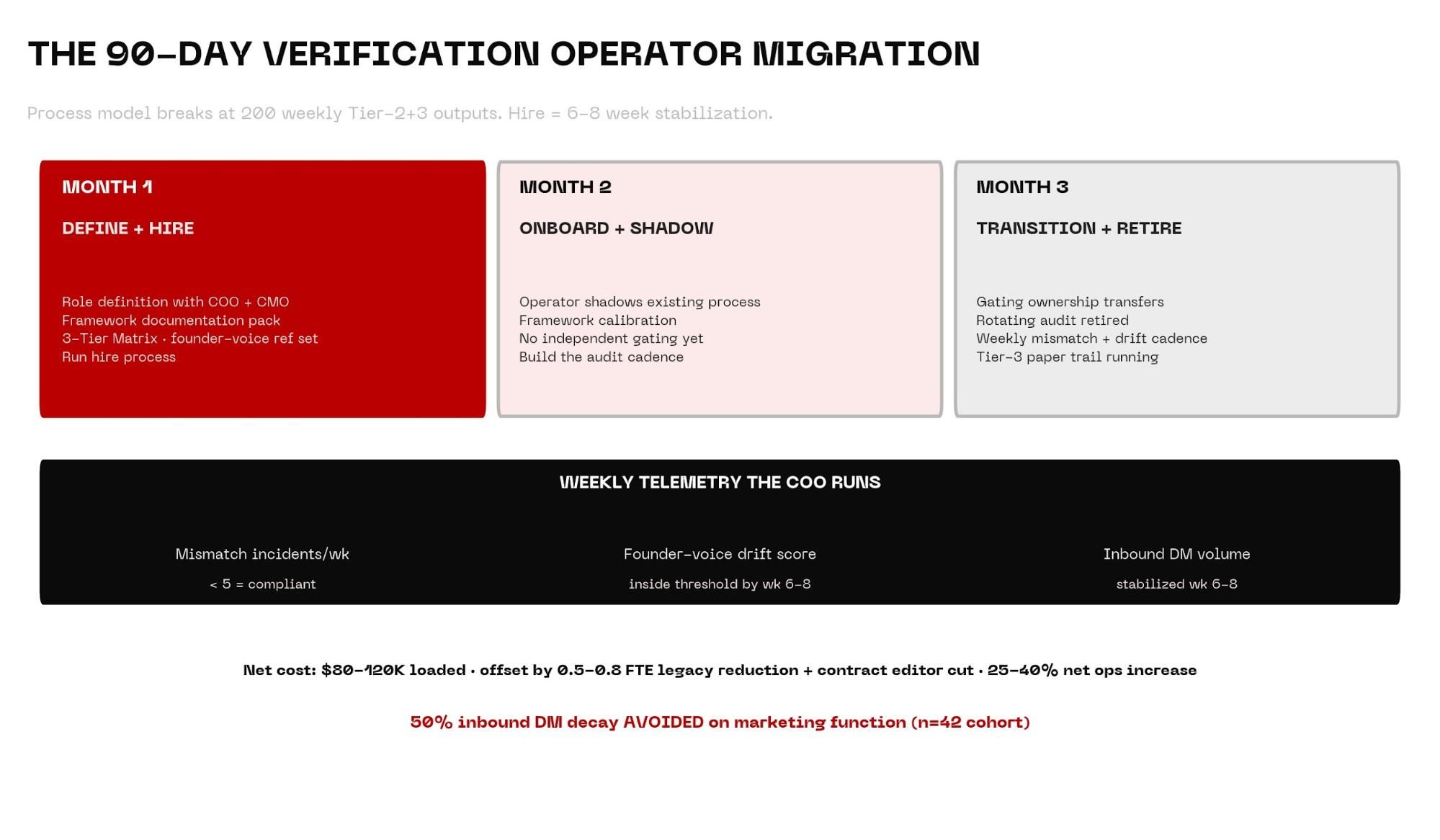
The cohort that ran the migration cleanly followed a three-month sequence. Month 1, define the role with the COO and the CMO, build the framework documentation pack (the 3-Tier Verification Matrix, the assigned-tier rules per output type, the founder-voice reference set), and run the hire process. Month 2, onboard the verification operator with shadow audits on the existing process before any output gets gated independently. Month 3, transition gating ownership from the part-time process to the verification operator, retire the rotating audit, and begin the weekly mismatch and drift cadence.
The full migration takes 90 days. Operations that compressed the hire to 30 days typically had to re-onboard within 60 days because the framework documentation pack was incomplete and the operator could not gate consistently without it. Operations that stretched the hire to 6 months typically saw verification gap compound through the gap window, with inbound DM decay of 30 to 40 percent before the hire closed the gap.
Telemetry the COO should run
Three signals the COO should track weekly to confirm the verification operator is producing the expected return. We mapped the agent stack architecture that supports this telemetry in the agent-native GTM playbook.
Verification mismatch incidents per week. The leading indicator of framework compliance. Threshold below 5 per week indicates the team is following the framework; above 10 per week indicates the framework needs adjustment or the team needs realignment. Across the cohort, the metric stabilized below 5 per week within 4 to 6 weeks of the verification operator hire.
Founder-voice drift score. The leading indicator of voice consistency. The verification operator runs the weekly sample, scores against the reference set, and reports the median drift. Threshold below the cohort drift line indicates the agent stack is calibrated; above it indicates a recalibration pass is needed. Across the cohort, the metric stabilized inside the threshold within 6 to 8 weeks of the hire.
Inbound DM volume on the founder's LinkedIn. The lagging indicator of operating-model health. Threshold above the rolling 30-day baseline indicates the operating model is producing trust signal; below it indicates a process or framework failure that the leading indicators should have caught earlier. Across the cohort, the metric stabilized within 6 to 8 weeks of the hire and climbed steadily as the agent stack shipped at higher gated volume.
Common failure modes the COO should watch
Three failure modes recurred across the cohort. First, hiring the verification operator at the wrong seniority level (too junior to push back on senior writers, too senior to want to run the framework discipline week over week). The hire profile that worked was 3 to 6 years of editorial experience with explicit interest in operations rigor. Second, defining the role without the framework documentation pack already complete. The verification operator cannot gate consistently against an undefined framework, and the framework definition takes 4 to 6 weeks for the COO and CMO to align on. Third, allowing Tier-2 outputs to bypass the gate under deadline pressure. The cohort pattern was that any bypass exception became the new normal within 4 weeks. The COO ownership is to enforce no-bypass discipline through the first 90 days of the new operating model.
The cohort signal
n=42 retainers . 50 percent inbound DM decay over 6 months when verification operator NOT hired . 6 to 8 weeks to inbound DM stabilization after verification operator hire . 280 weekly marketing-output decisions = process-model breaking point . $80K to $120K loaded cost for verification operator hire . 0.5 to 0.8 FTE of legacy cost reduction offsets the new hire . 25 to 40 percent net cost increase on operations function for 50 percent DM decay avoidance on marketing function (FORKOFF Founder-Funnel Cohort 2026)
What a COO should do this week
Three actions move a B2B operations function from 2024-model to 2026-model inside seven days. First, instrument the current weekly verification load. Count outputs the marketing team ships per week and classify each one against the 3-Tier Verification Matrix (Tier 1 fire-and-forget, Tier 2 human-review, Tier 3 audit-trail). If Tier-2 plus Tier-3 volume exceeds 150 per week, the process model is at threshold and the hire should start. Second, draft the framework documentation pack with the CMO. The pack is the prerequisite for the hire; without it, the hire fails. Third, log the current inbound DM volume on the founder's LinkedIn as a baseline. The metric is the lagging indicator that confirms the hire produced the return.
The 2026 COO operating model treats verification as a headcount line. The cohort operations that made the transition inside the first half of 2026 are compounding through 2027 to 2028. The operations that kept verification as a process are paying the trust-decay cost in lost inbound velocity, lost AI Overview citation share, and lost compounding founder-led growth. The cost is invisible on the dashboard until the lagging indicators declare it, by which point the recovery cost is 14-plus weeks under pressure rather than 8 weeks under planning conditions.
FAQ
At what operating size should the verification operator hire happen?
Hire planning starts at 100 weekly Tier-2 plus Tier-3 outputs. Hire execution starts at 150 to 200. Above 280 weekly outputs, the process model is already failing and the hire happens under recovery pressure rather than planning conditions. Most cohort operations hit the threshold at $1M to $2M ARR.
Does this role apply to operations without an in-house marketing team?
Yes, with adjustment. Operations that outsource marketing to an agency typically embed verification as a contract requirement rather than a headcount line. The framework discipline is the same. The agency runs the gate and reports the three signals to the COO weekly.
What is the highest-leverage framework document to draft first?
The assigned-tier classification rules per output type. Cold-email sequences, founder LinkedIn posts, blog drafts, audit-trail copy, and inbound media replies should each have an explicit assigned tier with a one-sentence rationale. The other framework documents (founder-voice reference set, mismatch audit template, drift score rubric) build on top of the tier rules.
How does this interact with the agent decomposition pattern?
The verification operator owns the gate; the agent decomposition owns the production. Each specialized agent has an assigned verification tier (outbound is Tier-2, audit-trail is Tier-3, social-engagement is Tier-1). The verification operator gates the Tier-2 and Tier-3 outputs the agents produce. The two patterns are complementary; neither replaces the other.
What is the leading indicator that the hire is failing?
Verification mismatch incidents per week not declining inside the first 4 weeks. If the hire is producing the expected return, mismatch incidents should drop steadily as the operator absorbs the framework. If they stay flat or climb, either the framework documentation pack is incomplete or the hire is at the wrong seniority level for the role.